


Prelim Biology: Passive Transport
5 Mins Read | By Simon Tang
Key Points Summary
- Passive transport is a mechanism that does not require the use of energy to move a substance.
- It’s generally very slow, and goes from a high to a low concentration gradient.
- The two main types are diffusion and osmosis.
- Diffusion is the overall movement of particles from a region of high concentration to a region of low concentration, that is, down the concentration gradient. E.g. salt dissolving in a cup of water.
- Osmosis is the movement of the water itself to balance the concentration. This could be because there is a semipermeable membrane preventing the water from moving around. It achieves the same goal as diffusion (equilibrium) but has a different means of doing it.
Content

Prelim Biology Passive Transport Definitions
In preliminary biology, passive transport is a way for cells to move substances around the body without using any energy. Many things in your body, like salts and water, are transported this way, and it saves the body energy.
It relies on a principle called ‘Brownian motion’. Basically, all small particles (atomic size!) vibrate and move around, and as they randomly collide with each other, they will eventually evenly spread themselves apart in a medium, like water. This is consistent with all particles, but it is especially seen in high energy particles, like ones found in naturally liquid or gas form.
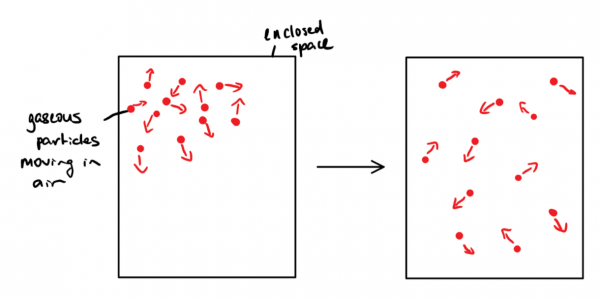
Thus, as shown above, if you have a region of an enclosed space with a high concentration of particles, due to Brownian motion, it will evenly intersperse. The difference between the high and low region is called the concentration gradient.
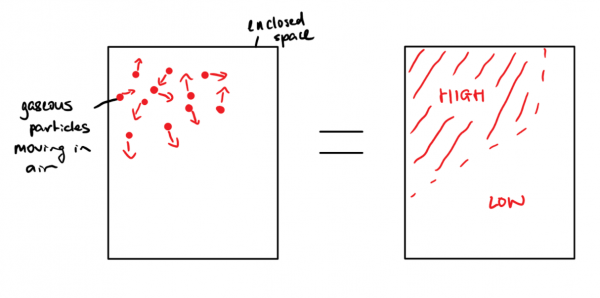
There are two main types of passive transport: diffusion and osmosis. Let’s learn about them!
What is Diffusion?
Diffusion is the overall movement of particles from a region of high concentration to a region of low concentration, that is, down the concentration gradient. This is most similar to the diagrams above.
The main passive transport example of diffusion in the body is gaseous exchange.
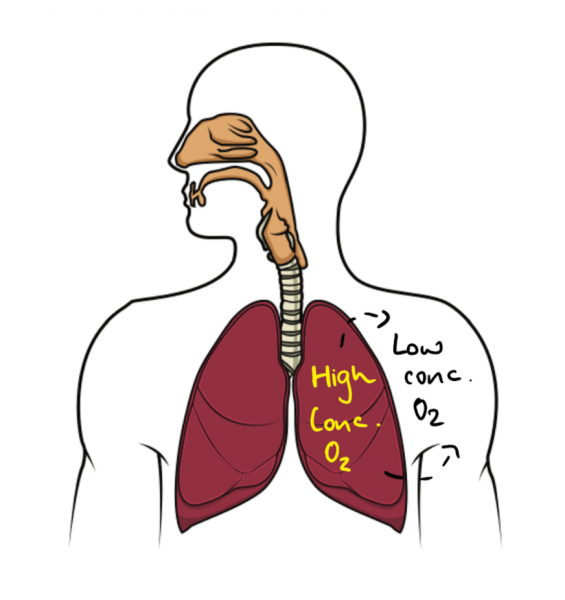
When you breathe in air, your lungs are filled with oxygen. This creates a concentration gradient with the blood vessels around your lungs, which are low in oxygen.
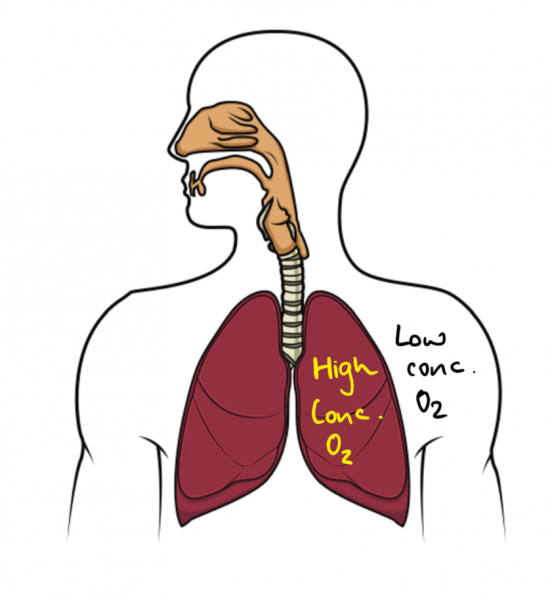
Thus, oxygen will naturally diffuse into your blood, ensuring that your body gets enough to generate energy.
But what is osmosis?
What is Osmosis?
Osmosis is a very important form of passive transport which involves the transport of water molecules through a semipermeable* membrane down the water potential gradient.
*Semipermeable means that certain molecules like water (shown in blue below) can pass through, whereas some ions cannot (e.g. salt shown in green). Examples include cell plasma membrane.
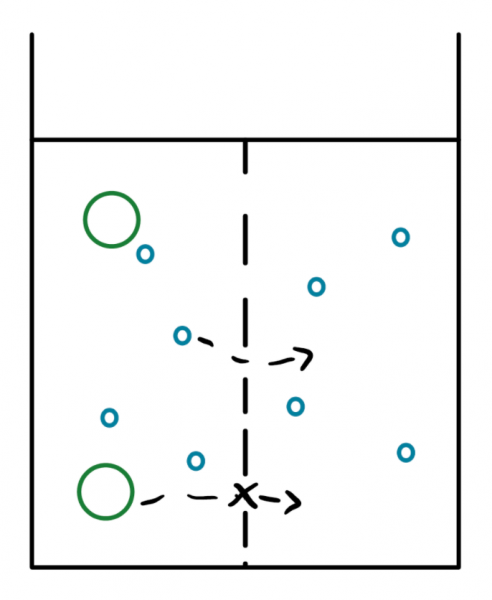
In the diagram above, we’ve put in a lot of salt on the left hand side of the membrane. This means that the concentration is high on the left and low on the right:
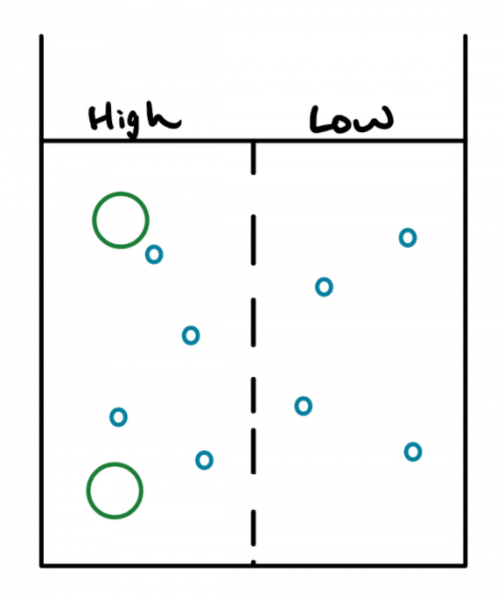
Without the semipermeable membrane, the salt would easily be able to move to the right side of the water via Brownian motion (diffusion). However, this is not possible.
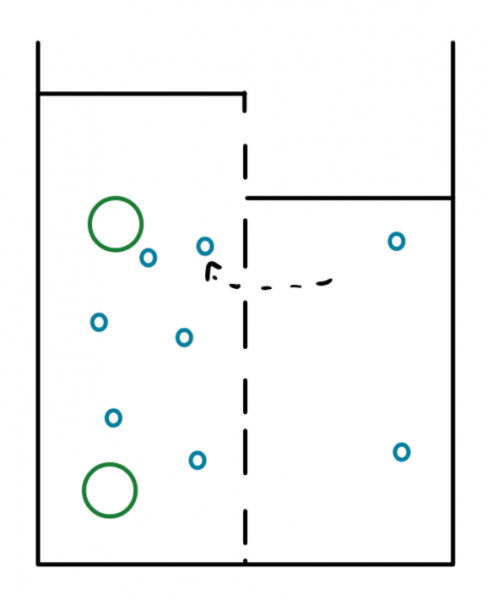
What happens instead is that the water moves from a low concentration environment to a high concentration environment. This is because a pressure gradient called osmotic pressure has been generated, and water is drawn to the high concentration area to dilute it as best that it can. When this happens, the water level on the left will actually rise.
Perhaps a gruesome example of osmosis at work is if you have ever put salt on a snail. This is a common way of killing them, because their skin acts as a semipermeable membrane. The salt on their skin makes the outside environment much more concentrated, so water from inside the snail is drawn out. This will cause the snail to shrivel up and eventually die.
Conclusion
So there you have it! We’ve gone through what is passive transport and passive transport examples. Check out some other blogs that we have on our website